
Why Can I Dream It but Not Do It? The Science Behind Dancing in Your Dreams

Picture this: You’re in class, onstage, or even in the supermarket aisle, and you’re dancing your heart out. You push off for a pirouette, and, suddenly, you’ve entered a never-ending loop of perfect rotations.
Unfortunately, this is just a dream. You wake up feeling excited but confused, and even a little frustrated. You could swear you remember what it felt like to execute all those turns—with perfect placement, no less. But in class, you just can’t do it.
Nearly every dancer has experienced at least one dream like this, whether with endless pirouettes, fearless jumps, sky-high kicks, or super strength. How is it that dancers can achieve certain feats in their dreams but not in real life?
To find out, Dance Spirit spoke with Dr. Julia Basso, PhD, CYT, director of the Embodied Brain Lab and co-director of the Science and Art of Movement Lab at Virginia Tech.
Your Brain on Sleep
To better understand this phenomenon, it helps to get a sense of what’s going on in the brain overnight. Basso explains that dreams are most vivid and story-like during the rapid eye movement (REM) portion of the sleep cycle, in which the brain processes emotional memories and integrates new information.
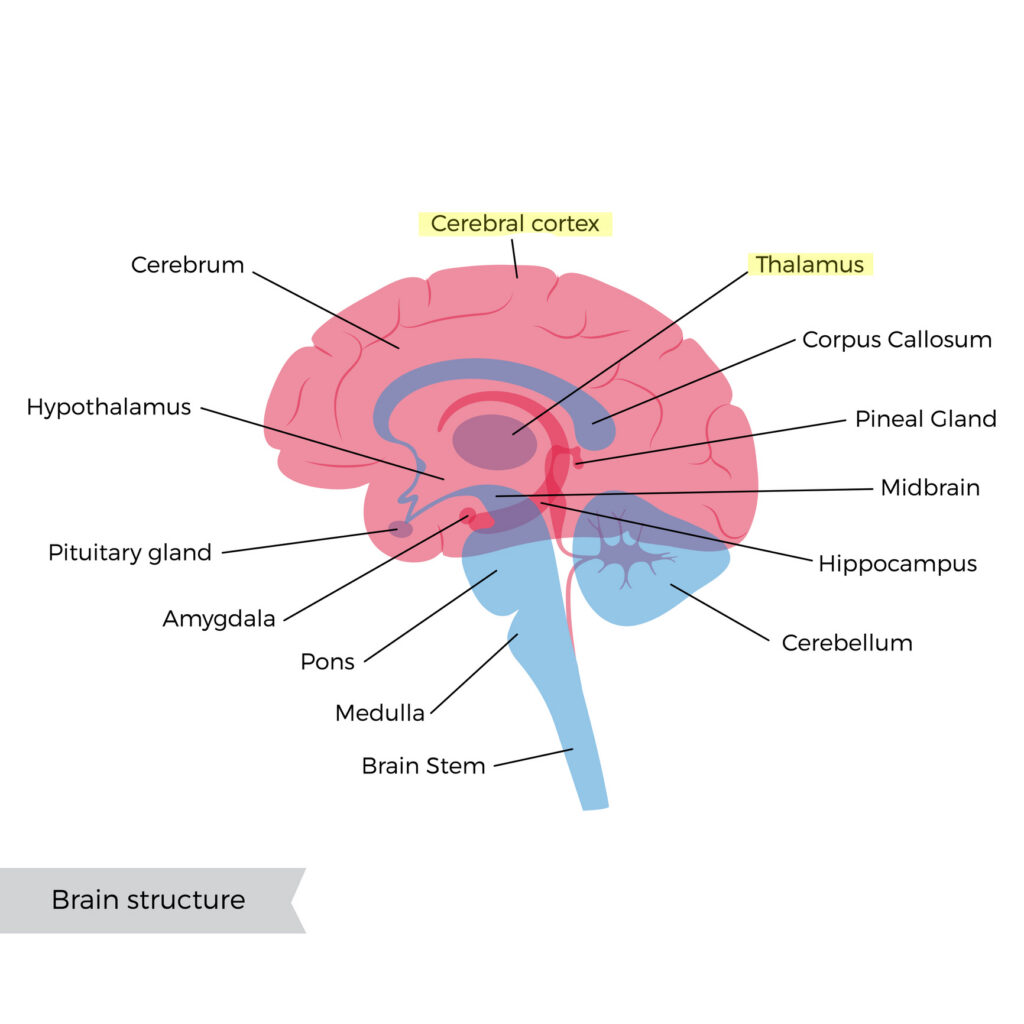
During wakeful hours, the thalamus (a structure in the middle of the brain responsible for relaying information) sends signals from the external world to the cerebral cortex, the outermost layer that processes sensory input, complex thinking, and language. That helps people navigate and make sense of our experience, Basso explains. But during sleep, the thalamus stops that flow of information, so the sleeping brain begins to generate its own imagery. (The prefrontal regions responsible for logic and self-monitoring also go relatively quiet during sleep, adds Basso, so that internally generated imagery unfolds without a reality check.)
“That’s where the dream world comes in,” she says. “We have this space where the body doesn’t have to adhere to physics.” That helps explain why it’s possible to do hundreds of turns in a dream, for example, or pause in the air mid-jump.
Mind’s Eye
Yet dancers may dream of feats that are possible in real life, like performing with impeccable technique or greater flexibility. Basso theorizes that if a dancer hasn’t achieved something physically but can visualize what the end result should look like, they can likely “feel” or “do” it in a dream—whereas while awake, you’re subject to your body’s physical limits.
She points to the brain’s “action observation network” (AON) as a major player in this phenomenon. The AON, she explains, is a large network of brain areas that activate while observing another person’s actions. Functional magnetic resonance imaging (fMRI) has shown that those areas also activate while executing the same tasks yourself—which Basso describes as a “mirrorlike” property. In effect, says Basso, the AON helps us conceptualize how others move and how it may feel. “We do that as dancers all the time,” she adds. “If you watch professionals, you can get a sense for how it feels to move like them.” That’s especially true if you’re familiar with the movements or choreography.
Because of that ability to conceptualize feelings and sensations, says Basso, dancers can imagine themselves performing at a level that doesn’t reflect their physical ability. “The brain is learning these movements before the body can catch up.” So while the brain processes the day’s events during sleep, the information gained from imagining those sensations might show up in a dream.
Just Keep Spinning
During REM sleep, the combination of lax physics and heightened memory processing can make way for some creative results. “When you have a basis of a movement, your brain can predict and extrapolate,” says Basso. That’s why if a dancer can understand the feeling of doing three pirouettes, they could imagine (or dream) doing, say, 11.
Basso theorizes that as the brain’s neural connections increase, a person’s ability to feel and understand others’ movement through the AON becomes more efficient. And dance—which requires a complex combination of sensory and motor skills, rhythm, emotion, and socialization—strengthens those neural connections. That may make it even easier for dancers to imagine what something may feel like, even if it’s technically impossible.
Dream It, Do It
Dreaming exciting feats can be fun, but could it also be useful? Waking up with a sense of how it felt to execute certain movements could be something to harness and use in real life. “It’s like why people study before sleep,” says Basso. “Because all that information is being processed once again during dreams, we can get to rehearsal the next day and probably perform better, with a little bit more nuance in the movement.”
Ultimately, there hasn’t been much research on how using dream sensations can translate directly to real-life results. But Basso finds the idea fascinating and worthy of study. Either way, she says, if dreaming of endless pirouettes or higher legs helps you feel more confident working on those things in real life, that’s not something to sleep on.


